The oldest view of Morpeth?

As part of the Heritage Open Days 2016 programme – a couple of recently restored Town Treasures were placed back on display in the Council Chamber.

The first is an 18th century oil painting said to be the oldest picture in existence of the main part of the town. The recently updated Town Treasures [1] guide says:

 “It had been on exhibition in the Laing Gallery, Newcastle, where it was seen by the late Colonel J.J. Gillespie.  He recommended the Town Council of the day to purchase it for its historic and artistic merit.  The Curator of the Laing though it might have been painted by Paul Sandby (born 1728) and certainly, as the 1738 part of the Chantry is clearly discernible, this would give weight to this suggestion.  It was considered to be a very early and rare example of a landscape done in oils.  Though it was expected to realise £250, the Corporation bought it for £60.  It was then exhibited in G.B. Grey’s shop in Bridge Street before it was hung in the Town Hall“.

The painting was very dirty, with areas of flaking painting and sagging in its frame.  It has now been cleaned and the flaking areas stabilised using a reversible process (to make future restoration easier). The conservator also chose to remove some areas which had been heavily overpainted at a later date, such as the river weir and some of the town buildings and retouch them to restore their original appearance.

Some interesting little details have emerged from the grime, such as a little red fox on the top of Ha’ Hill and various 18th century Morpethians walking and riding on the road in the foreground! 

The second item is a framed silk poster, entitled ‘Programme of Rejoicings at Morpeth’, and listing the events taking place in the town to celebrate the Marriage of Queen Victoria’s eldest daughter, Victoria, the Princess Royal, to Prince Frederick William of Prussia on 25th January 1858.
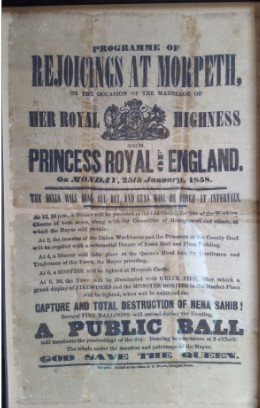

The marriage was unpopular due to Prussia’s neutrality in the recent Crimean War, but this is not apparent from the planned ‘rejoicings’ which included three separate dinners, one of which was for the inmates of the Union Workhouse and the County Gaol who were regaled with a substantial dinner of roast beef and plum pudding. Indeed, it must have been a noisy day in Morpeth as the bells were rung all day and guns were fired at frequent intervals.

At 6.30pm the town was illuminated with ‘Greek fire’ (a flammable substance which burns on water) after which there was a grand display of fireworks and a ‘monster’ bonfire in the market place.

This was followed by ‘the Capture and total destruction of Nena Sahib!” – presumably a theatrical re-enactment of the defeat in 1857 of Nana Sahib, an Indian aristocrat who rebelled against British rule and captured the city of Cawnpore.

The celebrations ended with a public ball at 9pm. A busy day for the Mayor!

A skilled restorer specialising in textiles had to take great care to remove an old ‘repair’ to the poster, done very inappropriately using sellotape!  While some marks can still be seen, the poster has now been stabilised, cleaned and reframed, and looks much better.

Why a poster on silk?  We can only guess that since silk lasts much longer than paper and was expensive, the poster was intended to be kept as a royal souvenir.

Footnote:

[1] The “Town Treasures” guide referred to is a revised edition produced in 2014 available from both the Town Council and the Antiquarian Society. The Guide itself probably merits a blog article so watch this space!

Sewer Gas Lamp, High Stanners

Article written in 2013 by Barry Mead, then Heritage Officer with Greater Morpeth Development Trust

Morpeth’s last remaining sewer gas lamp has been conserved and was re-erected on the High Stanners close to the Skinnery footbridge in June.

Sewer gas lamps were invented in the 1890s by a Birmingham man, Joseph Webb,   primarily to destroy sewer smells and germs.  They were a great success as their rate of extraction is still regarded as fantastic, each lamp capable of ventilating ¾ mile of sewers. Some of these lamps even ventilated the septic tanks and post mortem rooms of large hospitals.  The Morpeth gas lamp was placed to vent sewer gases from the sewer siphon that runs under the river from the Mitford Rd side to the High Stanners. Places such as Sheffield, Hereford, Winchester, Poole, Hampstead and Weymouth all installed Webb sewer gas lamps but one of the last strongholds is nearby  Whitley Bay where the lamps have been converted to run on electricity. A sewer gas lamp in Seaton Sluice is Grade 2 Listed.

The Morpeth lamp isn’t Listed but, as the only remaining sewer gas lamp in Morpeth, it was considered worthy of conserving. Fortunately, the flood defence works proved an excellent catalyst for the project. The lamp was located on the line of one the proposed flood defence banks and therefore had to be moved. Barry Mead from GMDT liaised with the Environment Agency who generously agreed to lift the lamp and put it on a lorry which took the lamp down to a specialist conservator in Oldham. When the lamp was returned, the EA arranged to concrete the lamp into the agreed location (as close as possible to its original position). On top of all this the EA also contributed £1,500 towards the conservation cost.  NCC’s Conservation Team also contributed a similar amount for which we are extremely grateful.

It has not been possible to convert Morpeth’s lamp to run on electricity but at least we have saved a small but significant part of the town’s heritage.

Addendum April 2020: In fact there is a second sewer gas lamp in Morpeth, at the foot of Cottingwood Lane. This was also disconnected and restored – but has recently (within the last three months) suffered destructive “making safe” procedures at the hands of an uninformed utility company.

150 years of the Chamber of Trade?

In 2018, the Morpeth & District Chamber of Trade “chose” to celebrate their 150th anniversary. This article by Chamber Chairman Ken Brown explains why:

Until a couple of years ago, it was believed that the Chamber of Trade has only been in existence since the 1950s. However, after research by Chamber members, it has been discovered that a predecessor of the Chamber was already active way back in 1868, as evidenced by a Morpeth Herald article referring  to the “Chamber of Commerce” holding their “usual meeting” in the Black Bull. So, Morpeth and District Chamber of Trade chose to celebrate their “150th anniversary” in 2018.

The Organisation has changed its name a few times in its 150 years. In 1903 it changed from “Morpeth Chamber of Commerce” to the “Morpeth Tradesmen’s Association”. This lasted until 1943 when the then Chairman, Malcolm Wood, became despondent at the apathy of local traders in responding to the threat of the German Luftwaffe,  despite having established a mutual aid scheme to provide aid to traders whose property was damaged by enemy action.  In the hope of broadening its appeal, the Association changed its name back to the Morpeth and District Chamber of Commerce. Since the 1960’s it has been known as the Morpeth Chamber of Trade.

Many of the issues dealt with by the Chamber over the years continue to return…  For example, in 1906 there was an angry response to the “foolish proposal” of not permitting horses and carts to stand in Bridge Street for unloading as they were continually being moved on by the police.

In 1949, there was a plea to remove parking charges (only the Terrace Car Park was free at the time). There was also outcry when it was claimed that cars were being forced off the main street by police as the proposed bypass wasn’t likely to happen for a number of years. Sounds familiar doesn’t it!

In the late 1960s, the Chamber launched “The Morpeth Rant” a free publication for the people of the town. This carried news, in particular news relating to businesses and the development of the town and much more besides.

At that time, the town’s Christmas Lights were hand-made and erected by members of the Chamber of Trade – probably something that would scare the pants off Health and Safety experts in the current era. It was very labour intensive and became more and more expensive – so Fair Day was created primarily to provide funds for the Christmas Lights.

On Easter Eggs

Here’s something on Northumbrian Easter traditions in an extract from the blog Scranshums – see the full article at https://scranshums.com/2015/04/04/on-easter-eggs/

In the UK, decorating hard-boiled eggs was mainly popular in the North of England and south of Scotland, where they were called “pace-eggs” (or “peace-eggs”, “pash-eggs” and “paste-eggs”). This definitely existed by 1579, when the author of the Beehive of the Romish Church wrote that they were a silly superstition that should be discarded. They weren’t, and this still continues today, thanks in part to the Victorians who encouraged children to decorate eggs and helped the tradition spread across the whole country (their equivalent of something going viral, perhaps?). Traditionally, boiling the eggs with onion skins turned the eggs brown, and different design effects could be created by winding wool around an egg, or wrapping it in leaves. Nowadays I’ve been known to use felt-tip pens and Doctor Who stickers.

The fun didn’t/doesn’t end with decorating eggs, however. They’d then be used by children in various games, such as “jaapin” where you hold the egg in your fist, the pointy bit sticking out between your second and middle fingers, and then you smash it into your opponent’s pointy end. Winner is the one whose egg remains intact. “Boolin” is another custom which is still popularly practised, for example in my home town of Morpeth: lots of people gather in the park and bowl their eggs down a hill to see whose goes furthest and doesn’t break. One 1909 antiquarian article from Northumberland, quoted by Roud, mentions rolling the eggs up a hill, which is unusual to say the least. I am rubbish at this game, and try as I might I can’t find any decent strategies for winning.

The Oliver Family

Alison Byard writes about the family who gave their name to Olivers Mill:

A few months ago, I was reminded that two portraits used to hang over the staircase at the Old Cottage Hospital, which trustees of the Hollon Trust thought might have been Richard and Mary Hollon.

We decided to ask Northumbria Healthcare Trust what became of these portraits after the Cottage Hospital closed. We got a response fairly quickly, including photos of the paintings, which turned out to be not Richard and Mary Hollon, but Robert Oliver, and his wife Margaret Scott Oliver, of Messrs Oliver Ltd, bakers and confectioners in Bridge Street and the Market Place and owners of Wansbeck Flour Mills, now known as Olivers Mill. The Olivers were generous donors to the early Cottage Hospital in Bullers Green.

The paintings were originally a gift to the Olivers from their three sons (John, Robert and William) on the occasion of their Golden Wedding Anniversary in 1894. They were presented to the Cottage Hospital when the 1939 extension was opened by their grandson Mr C G Hudson, in memory of the great contribution made by his grandparents. The Olivers’ son John had also bequeathed a large part of his estate to the hospital.

The artist is Thomas Bowman Garvie (1859 – 1944), also a Morpeth man, who lived at Bow Villa in Newgate Street. He was a fine painter and some of whose other work can be seen in the Town Hall – including his painting ‘Man feeding his Cat’ [1] in the Council Chamber, and the portraits of George Barron Grey and George Young in his mayoral robes on the staircase. Garvie subsequently moved to Rothbury where he was much employed by Lord Armstrong in painting portraits of his family, which can be seen at Cragside.

[1] We now think the portrait of the old bearded man with his cat, in the Council Chamber, may be of the artist’s father, Edmund Garvie.